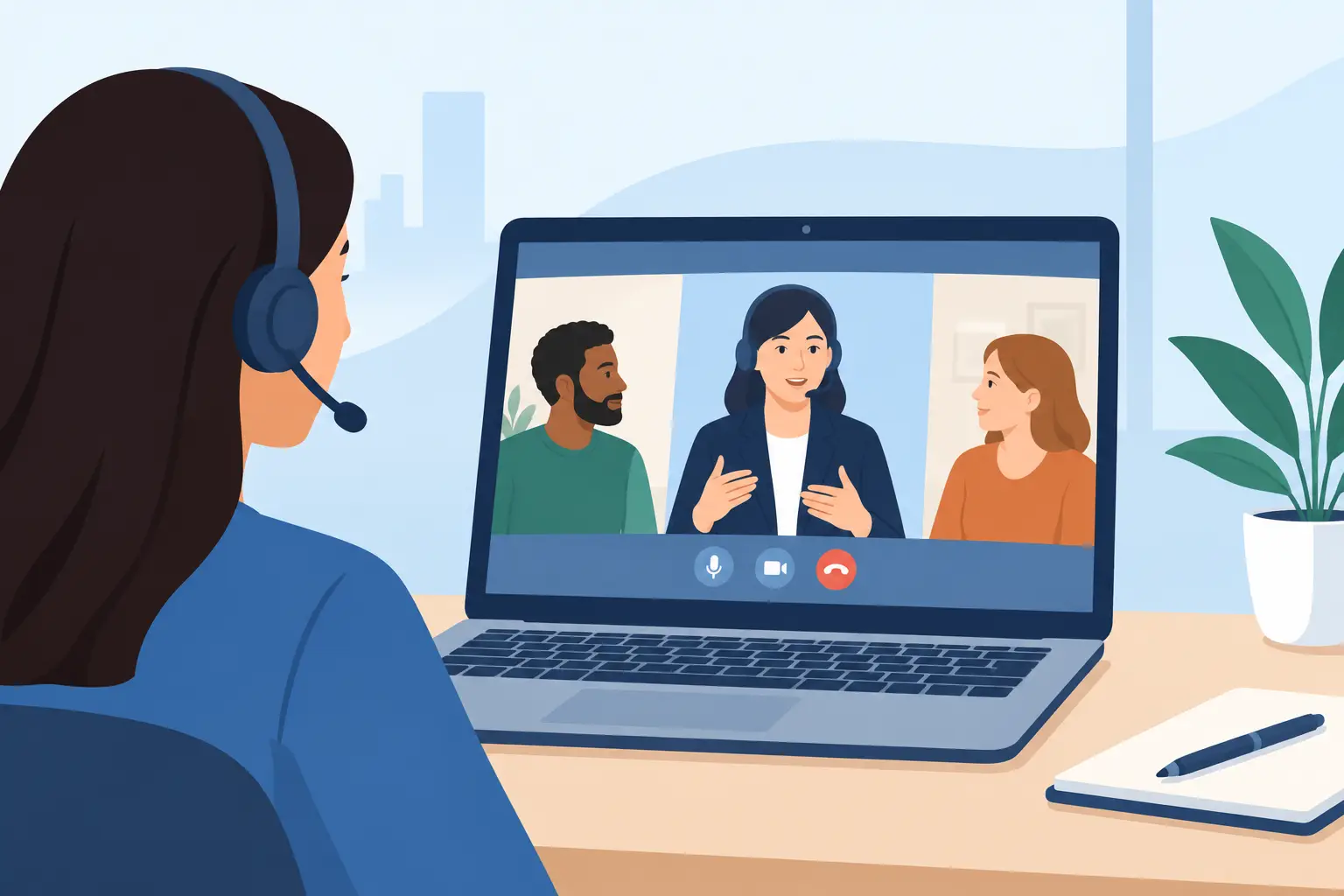
A patient arrives for an unscheduled clinical visit. A student needs to speak with an advisor before registration closes. In both situations, waiting hours or days for communication access is not an acceptable operational plan. What is video remote interpreting? It is a service that connects a Deaf or hard-of-hearing participant with a qualified sign language interpreter through a secure live video connection, allowing the conversation to take place when an in-person interpreter is not practical or necessary.
For healthcare providers, schools, and other institutions, video remote interpreting is more than a video call with an interpreter added. It is a coordinated accessibility service. The quality of the technology, the interpreter's qualifications, the privacy of the session, and the scheduling process all affect whether the interaction is clear, timely, and appropriate for the setting.
What Is Video Remote Interpreting?
Video remote interpreting, often called VRI, enables an interpreter to participate from another location using video and audio technology. The Deaf or hard-of-hearing person, the hearing participant, and the interpreter can see one another in real time. This visual connection is essential for sign language interpreting because interpreters must be able to see signing, facial expressions, body language, and other visual elements of communication.
A typical VRI session may take place on a tablet, laptop, mobile device, or dedicated video setup. In a medical environment, the patient and clinician may be in the same exam room while the interpreter joins remotely. In education, a student may be with a teacher, administrator, counselor, or disability-services professional while the interpreter appears on screen.
The goal is straightforward: provide effective communication without treating distance, short notice, or limited local availability as a reason to delay access. VRI can support scheduled appointments as well as urgent needs, provided the organization has a dependable process for requesting and launching the session.
How Video Remote Interpreting Works in Practice
VRI works best when it is treated as a planned service workflow rather than an improvised technology fix. The organization requests an interpreter for a defined date, time, setting, and expected duration, or initiates a request for immediate coverage when that option is available. The provider assigns a professional sign language interpreter, confirms the session details, and supplies the appropriate connection process.
At the start of the appointment or meeting, staff position the device so the interpreter can clearly see the Deaf participant. The participant must also have an unobstructed view of the interpreter. Good lighting, a stable internet connection, audible sound for hearing participants, and a screen large enough to see signing clearly all matter. A shaky phone held at an awkward angle may technically create a connection, but it does not create reliable access.
During the session, the interpreter facilitates communication between participants without directing the conversation or making decisions for either party. The interpreter's role is to interpret accurately and impartially. In sensitive settings, professional boundaries and confidentiality are central to the service.
Afterward, organizations benefit from clear records of scheduled sessions, fulfillment status, and service details. For teams coordinating many appointments across departments or campuses, robust scheduling and real-time tracking reduce the uncertainty that often surrounds interpreting requests.
VRI Is Not the Same as Video Relay Service
Video remote interpreting and Video Relay Service, or VRS, are sometimes confused because both use video and sign language interpreters. They serve different purposes.
VRS is designed primarily for telephone calls between a Deaf sign language user and a hearing person. The Deaf caller connects with an interpreter by video, and the interpreter voices or signs the conversation over the phone. VRS is not a replacement for an interpreter in a medical examination, classroom conference, disciplinary meeting, or other institutional interaction where participants need to communicate directly in the same setting.
VRI is arranged to support a specific interaction. It is particularly useful when an organization needs an interpreter for an appointment, consultation, meeting, lesson, or other live conversation but does not need the interpreter physically present in the room.
Where VRI Fits Best
Healthcare and education settings often benefit from VRI because communication needs can be time-sensitive, distributed across locations, and difficult to predict. A clinic may need coverage for follow-up visits, intake discussions, specialist consultations, or discharge planning. A school or university may use VRI for advising, parent meetings, administrative appointments, tutoring, or remote instruction.
VRI can be especially valuable when an in-person interpreter cannot arrive quickly enough, when a rural location has limited interpreter availability, or when a short appointment does not require travel time. It also gives organizations flexibility across multiple sites. A health system or school district does not have to rely solely on who happens to be available near each location.
That said, video access is not automatically the best choice for every encounter. A lengthy medical discussion, a complex educational evaluation, a high-stakes legal or disciplinary meeting, or a session involving significant movement may call for an in-person interpreter. The right modality depends on the participant's communication preferences, the complexity and duration of the interaction, the physical environment, and whether the technology can support clear visual communication throughout.
Why Interpreter Qualifications Matter
The video connection does not reduce the need for professional expertise. In fact, remote delivery can make expertise even more important. The interpreter must manage visual communication through a screen while preserving meaning, tone, and pace in a setting where misunderstandings can have real consequences.
Healthcare encounters may involve medical terminology, informed consent, treatment instructions, mental health discussions, or urgent changes in a patient's condition. Educational settings may involve specialized academic language, individualized education program discussions, student-support planning, or conversations with families. These are not situations for an unqualified person who happens to know some signs.
A professional sign language interpreter understands the ethics, confidentiality expectations, and role boundaries required for the assignment. Organizations should also consider whether the interpreter has experience relevant to the setting. A reliable interpreting partner helps match the request with an interpreter who can support the interaction appropriately, rather than viewing every assignment as interchangeable.
Building a Reliable VRI Process
The strongest VRI programs combine access to interpreters with operational discipline. Staff need to know how to request an interpreter, where to find the approved device or platform, and whom to contact if a session needs to be adjusted. Without those basics, even a well-designed service can fail at the moment it is needed.
For recurring use, organizations should establish a simple process that covers four practical areas:
- Scheduling requests early when the appointment is known, including location, start time, expected duration, and relevant setting details.
- Preparing devices, connectivity, lighting, and room layout before the participant arrives.
- Identifying an escalation path for delayed, changed, or urgent appointments.
- Reviewing fulfillment data to identify patterns such as frequent short-notice needs, no-shows, or locations with technology issues.
These practices help accessibility coordinators and scheduling teams move from reactive problem-solving to dependable service delivery. Real-time tracking is particularly useful when multiple appointments are occurring across a hospital system, campus, or district. Staff can see whether coverage is confirmed and address changes before they become a communication barrier.
Privacy, Confidentiality, and the Environment
VRI sessions may involve protected health information, student records, employment matters, or personal family conversations. The service should therefore be approached with the same care as any other confidential communication channel. Organizations should use approved technology, protect devices from public viewing, and avoid holding sensitive interpreted conversations in noisy hallways or open waiting areas.
The room itself also affects communication quality. Backlighting can make signs difficult to see. A participant sitting too far from the camera may be unclear to the interpreter. Interruptions and overlapping speech can slow the conversation and create avoidable confusion. A few minutes of preparation can prevent a much larger access problem.
Participants should not be asked to rely on family members, children, or untrained staff to interpret when professional services are needed. Beyond accuracy concerns, those arrangements can compromise privacy and place an inappropriate burden on the people involved.
Choosing Between Video and In-Person Interpreting
The practical question is not whether VRI is better than in-person interpreting. Both are important forms of access. The question is which option will support effective communication for this particular person and interaction.
VRI may be an excellent fit for a timely appointment with strong connectivity and a stable visual environment. In-person interpreting may be preferable when the encounter is lengthy, highly nuanced, emotionally demanding, or physically dynamic. Some organizations use both modes through one managed service partner, allowing schedulers to select the appropriate option without rebuilding the process each time.
For institutions that need dependable access, the value of VRI is not simply speed. It is the ability to provide professional interpreting through a coordinated, trackable process when communication cannot wait. A well-prepared request, the right interpreter, and a properly supported video environment give Deaf and hard-of-hearing participants a meaningful place in the conversation from the first minute.